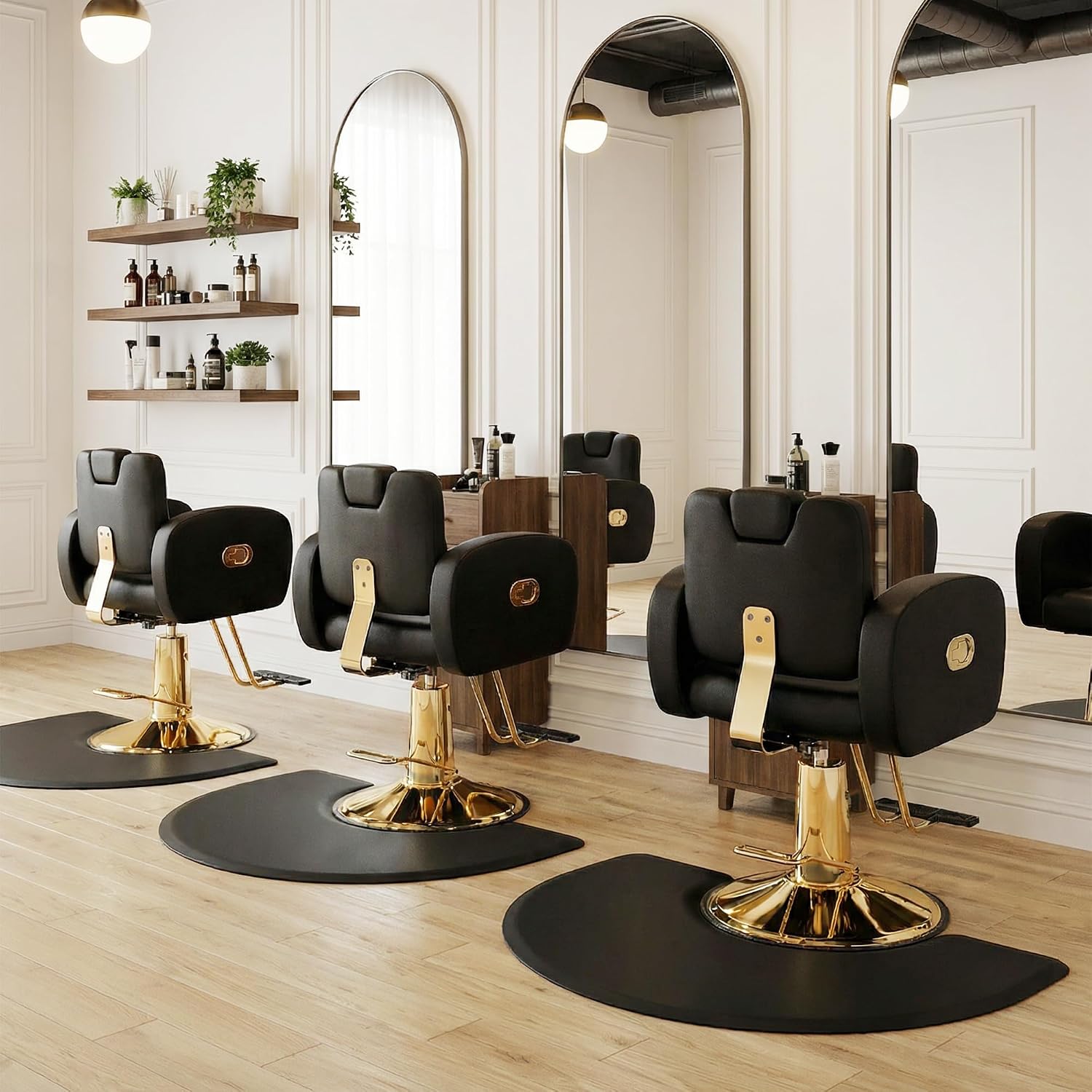
If you’re renting a booth or running a suite and your service menu goes beyond a single trade — say, you do braiding and lash extensions, or you offer waxing alongside cuts — you’ve probably already felt the friction of the wrong chair. A reclining all-purpose salon chair is exactly what it sounds like: a hydraulic (pump-raised and lowered) styling chair that also leans back fully or nearly flat, so one piece of furniture can serve a client sitting upright for a style and lying back for a facial, lash set, or body service. The pitch is obvious. The math behind whether it actually saves you money — or costs you in booking time, client comfort, and wear-and-tear — is less obvious. That’s what this guide is for.
If you’re currently under a booth lease or spec’ing a suite buildout and need to make a chair decision in the next 30–90 days, read this straight through. We’ll cover what separates budget chairs from durable workhorses, how to run the real cost-per-service calculation, and the specific tradeoffs between price tiers that matter for lash artists, tattoo booth operators, and braiders in particular.
| EDITOR'S PICK[Artist hand Professional Barber…](https://www.amazon.com/dp/B09TZKCKNR?tag=greenflower20-20) | Mid-tierBaasha Black & Gold Reclining S… | Budget pick[Artist hand Salon Chair for Hai…](https://www.amazon.com/dp/B0GY2XY8KG?tag=greenflower20-20) | |
|---|---|---|---|
| Reclining | ✓ | ✓ | — |
| Headrest | — | ✓ | — |
| Max Load | — | 440 lbs | 330 lbs |
| Color | — | Black & Gold | Black |
| Price | $315.78 | $249.99 | $159.99 |
| See on Amazon → | See on Amazon → | See on Amazon → |
Why “All-Purpose” Doesn’t Always Mean “Right for Your Menu”
The term all-purpose chair covers a wide range of designs. Some recline to about 135 degrees — enough for a shampoo tilt or a relaxed facial, but not flat enough for professional lash extension application, which typically requires a client to lie at 150–180 degrees. Others go fully flat but lack the headrest articulation that lash and brow artists need to position a client’s face precisely. Tattoo booth operators face a different constraint: they often need the chair to lock firmly at multiple angles mid-service, because a client shifting from an upright position to a recline while ink is in progress is a real hazard.
Modern Salon’s furniture buying coverage consistently flags this spec gap as the most common purchasing mistake in multi-service setups: buyers focus on the recline range advertised on the box and miss the lockout points — the specific angles at which the chair can hold position without drift. Drift (slow, unintended reclining under client weight) is a quality indicator. Entry-level chairs often have one or two lockout positions. Mid-range and professional chairs typically have five or more, or use hydraulic tension that holds any angle continuously.
What to spec for each service type:
- Lash extensions: Full flat or near-flat recline (150°+), adjustable headrest, stable footrest, quiet mechanism (clients close their eyes for 90+ minutes — mechanical noise matters)
- Tattoo work: Multi-position lockout at firm angles, high weight capacity (many chairs are rated 250–300 lbs; tattoo work may require 350 lbs for larger clients plus artist pressure), armrest adjustability
- Braiding: Upright position comfort, seat depth, and height range (braiders work standing; the chair height range — typically 18–24 inches from floor — affects back strain over a 6-hour day)
- Waxing/facials: Recline range, easy-wipe upholstery, paper roll holder or headrest cover compatibility
The mistake is treating these as interchangeable requirements. They’re not. If lash work is your primary income driver and braiding is secondary, you spec for lash and verify braiding works — not the reverse.
The Price Ladder: What You Actually Get at Each Tier
Entry Level: $200–$500
Chairs in this range — names like Salon Ambience, typically found through beauty supply distributors — are hydraulic, recline to around 135 degrees, and have basic foam padding. Owners in aggregated reviews consistently report that the hydraulic pump holds well for the first 12–18 months under daily use, then begins to drift or lose height retention. The upholstery at this tier is usually PVC rather than PU leather, which cracks faster under disinfectant spray (most stylists wipe down between every client).
Beauty Launch Pad’s multi-service chair coverage notes that entry-level chairs in this category are appropriate for part-time operators running fewer than 15 clients per week. At higher volume, the math flips: a $350 chair that needs replacing every 18 months costs more over three years than a $900 chair that runs five.
The math:
$350 chair × 2 replacements over 3 years = $700 spent
$900 mid-range chair, still running at year 3 = $900 spent — but you also avoided two replacement installations, two disposal fees, and the booking downtime during changeover.
Mid-Range: $500–$1,200
This is where most independent booth renters land, and for good reason. Chairs from brands like Pibbs Industries, Omwah, and Collins Manufacturing enter around $600–$800 and jump significantly in build quality: steel hydraulic cylinders with longer service life, multi-position recline lockouts, PU upholstery that holds up under EPA-registered disinfectants, and meaningful weight ratings (typically 300–350 lbs).
Collins in particular — an American brand with a long track record in the professional salon channel — has models in the $700–$1,000 range that are frequently cited by Salon Today and American Salon as workhorses for multi-service environments. Their all-purpose recliners include adjustable footrests, removable headrests, and chair bases that accommodate shampoo bowl attachment if your suite layout shifts later.
Professional Beauty’s ergonomics coverage highlights that mid-range chairs in this tier are where you start to see meaningful recline angles — typically 150–160 degrees — making them genuinely usable for lash extension services rather than just facials.
Professional/Premium: $1,200–$3,500+
Takara Belmont, Maletti, and Belvedere anchor this tier. For a multi-service operator, the case for spending $2,000–$3,500 on a single chair comes down to three factors: daily volume, service longevity, and brand positioning.
Takara Belmont’s hydraulic mechanisms are manufacturer-rated for significantly higher cycle counts than mid-range alternatives — the spec sheets on their professional-grade base units indicate ratings designed for 10+ years of salon use. Owners in long-run professional reviews consistently note that the pump shows no drift after years of heavy daily use. At 20+ clients per day, that durability gap is real money.
For lash studios specifically, Maletti’s reclining treatment chairs — which straddle the line between spa furniture and salon furniture — offer fully flat recline with articulating headrests and zero mechanical noise. They’re not cheap: expect $2,500–$3,500 for a properly equipped unit. But a lash artist billing $150–$250 per set, booking 6–8 sets per day, is running $900–$2,000 in daily revenue. At that volume, equipment failure or client discomfort has a real cost.
By the Numbers: Chair ROI at Different Service Volumes
| Weekly clients | Chair tier | Est. chair lifespan | Cost per week (amortized) |
|---|---|---|---|
| 10–15 | Entry ($350) | 18 months | ~$4.50/week |
| 10–15 | Mid-range ($800) | 5 years | ~$3.10/week |
| 20–30 | Mid-range ($900) | 3–4 years | ~$5.30/week |
| 20–30 | Professional ($2,200) | 8–10 years | ~$5.00–$5.30/week |
| 40+ | Professional ($2,800) | 10+ years | ~$5.40/week |
Amortization assumes straight-line depreciation over estimated lifespan. Does not include maintenance, hydraulic service, or upholstery repair.
The takeaway: at moderate-to-high volume, mid-range and professional chairs reach near cost-parity per week — and the professional chair carries dramatically less downtime risk.
The Tradeoffs Brands Don’t Advertise
Upholstery: This is the fastest-wearing component in a multi-service environment. Lash adhesives, wax residue, tattoo ink, and the aggressive disinfectants required for blood-adjacent services (tattoo, some waxing) all degrade vinyl and PVC upholstery faster than standard salon use. PU (polyurethane) leather is the minimum for a multi-service chair. Medical-grade or antimicrobial vinyl — available on select Pibbs and Belvedere models — is worth specifying if tattoo or body work is on your menu. American Salon’s equipment coverage notes that upholstery replacement on a $700 mid-range chair typically runs $150–$300 in labor and materials, so it’s not catastrophic — but it’s a recurring cost to factor in.
Base type: Most all-purpose chairs ship with a round hydraulic base. For tattoo work, a five-star caster base (wheels) makes repositioning mid-service dramatically easier — you can move the client rather than moving yourself. Verify whether your chair of interest offers a caster base option; not all do.
Headrest geometry: For lash work, a removable or adjustable headrest isn’t optional — it’s the difference between proper client positioning and neck strain for both the client and you. Verify that the headrest adjustment range works for clients across height ranges (roughly 5’0” to 6’2”).
Weight capacity: Per American Salon’s equipment reporting, the industry standard rating for professional chairs is 300–350 lbs. If your clientele regularly includes larger clients, verify the chair’s rated capacity before purchasing — this is a spec the manufacturer publishes, and it matters for both safety and warranty coverage.
The Decision Rule: If X, Then Y
Here’s the framework for making this call if you have a purchase pending:
If your primary service is lash extensions (90%+ of revenue): Don’t compromise on recline angle or headrest adjustability. Budget $800 minimum; the Pibbs and Collins mid-range options spec well for lash work. If you’re booking 20+ sets per week, evaluate the professional tier seriously — a Maletti or Takara Belmont unit will outlast two or three mid-range chairs at that volume, and client comfort directly affects rebooking rates.
If you’re a braider running a multi-service booth as secondary income: Your primary need is seat height range and upright comfort. A mid-range all-purpose chair at $600–$900 covers this well. Don’t overspend on recline specs you won’t use.
If tattoo work is on your menu: Weight capacity and multi-position lockout are non-negotiable. Go mid-range at minimum ($700+), verify lockout positions before purchasing, and strongly consider a caster base option. Upholstery should be PU or medical-grade vinyl — wipe-down resistance is a daily reality.
If you’re multi-service across all three categories: Invest in the professional tier, specify medical-grade upholstery, and buy from an authorized dealer with a service network. The chair is your primary revenue-generating tool. A gray-market unit with no warranty support is a liability, not a savings — and as Salon Today’s booth renter economics coverage notes, equipment downtime at a one-person operation has no buffer.
Authorized dealers for Takara Belmont, Pibbs, Collins, and Belvedere can be verified directly through each brand’s website; purchasing through unauthorized channels voids manufacturer warranties on most professional-tier equipment, which is a significant financial risk on a $2,000+ purchase.
The right reclining all-purpose chair doesn’t exist in the abstract — it exists for your specific service mix, your client volume, and the revenue you’re protecting. Run your own version of the amortization math above, spec against your primary service first, and buy from a source you can call when something goes wrong. That’s the whole decision.