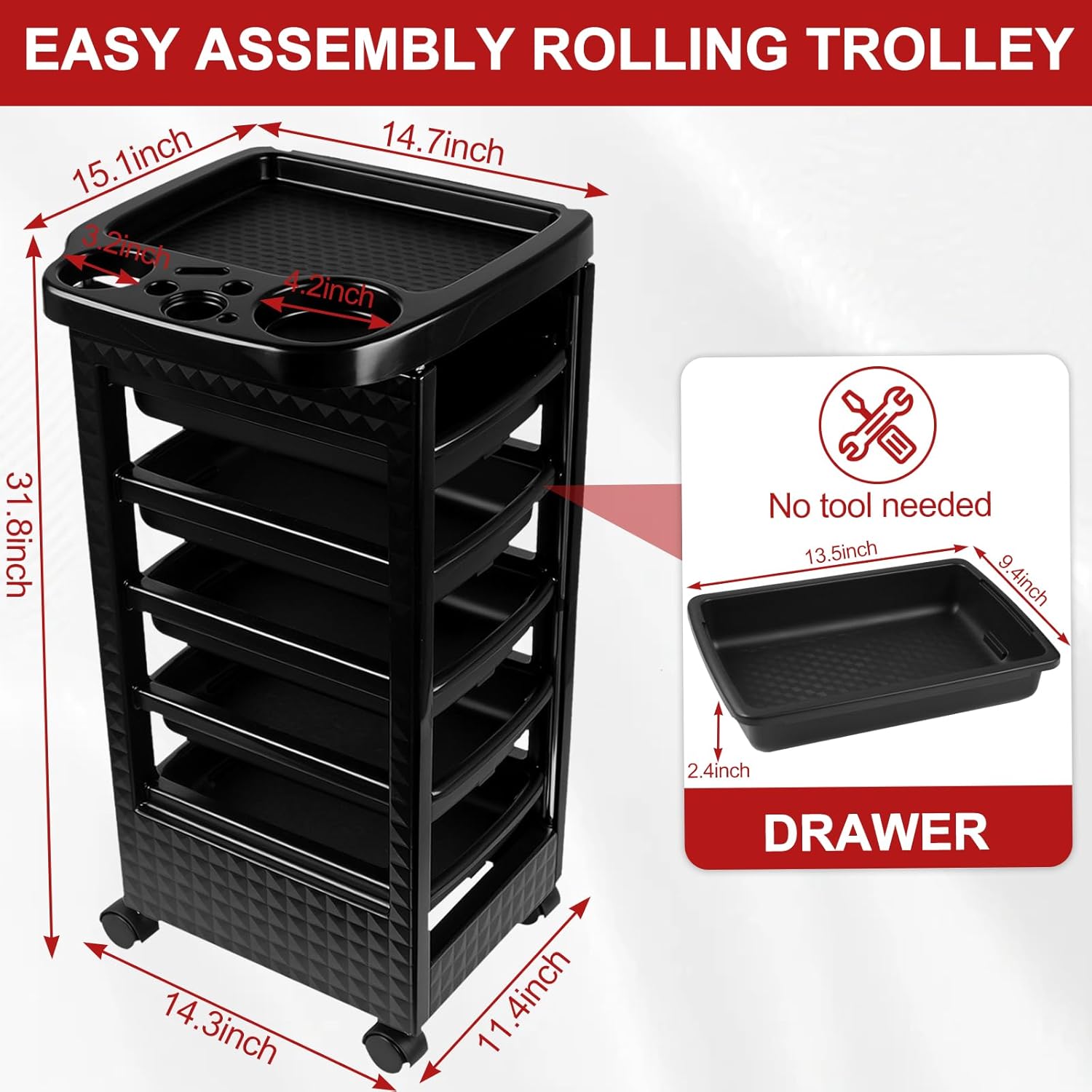
A salon trolley cart is exactly what it sounds like: a small wheeled cabinet — typically on casters (rolling wheels) — that sits beside or behind your styling chair and holds your tools, color supplies, and accessories within arm’s reach. If you’ve spent even one day hunting for a brush mid-foil or digging through a bag on the floor, you already understand the problem a good trolley solves. What’s less obvious is how much variation exists in this product category — from $35 open-shelf carts that wobble on the first spin to $400 aluminum tower units designed for a color-heavy book — and how the wrong choice quietly costs you time and money every single shift. This guide walks you through the real decision points: what specs actually matter for your workflow, how to read the price ladder honestly, and a clear framework for picking the cart that fits your station size, service menu, and budget.
| EDITOR'S PICK[TASALON Lockable Salon Trolley](https://www.amazon.com/dp/B0C887LJZL?tag=greenflower20-20)… | Mid-tier[TASALON Salon Trolley - Space S](https://www.amazon.com/dp/B08MPXGY37?tag=greenflower20-20)… | Budget pickSalon Trolley Cart with Wheels | |
|---|---|---|---|
| Drawers | 6 | — | 3 |
| Buckets | 2 | — | — |
| Traystotal | — | 6 | — |
| Lockable | ✓ | — | — |
| Hot tools | — | — | ✓ |
| Rolling | ✓ | ✓ | — |
| Price | $129.00 | $109.99 | $79.99 |
| See on Amazon → | See on Amazon → | See on Amazon → |
Why the “Cheap Cart” Math Usually Doesn’t Work Out
Let’s start with the honest version of this conversation, because the $35–$55 open-shelf plastic cart is the default starting point for most booth renters and new graduates, and it deserves a direct assessment.
Across aggregated reviews and buyer feedback cited in Salon Today Magazine’s booth renter coverage, the recurring complaint pattern for budget open-shelf carts is consistent: instability under load, wheels that lock up or roll unevenly on textured salon flooring, and shelves that bow when weighted with a full tool kit. That’s not a quirk of one brand — it’s structural. Most sub-$60 carts are engineered for light-duty retail display, not a working stylist’s daily rotation of heavy shears, blow-dryers, bottles, and color supplies.
The cost-per-use math here matters. A $40 cart that needs replacing every 8–10 months costs more over two years than a $120 cart rated for professional daily use. Modern Salon’s station equipment coverage notes that professional-grade trolleys from established salon equipment lines are typically spec’d for 20–30 lbs of distributed load per shelf — a figure that budget units rarely publish, let alone meet.
By the numbers:
- Budget plastic cart (sub-$60): avg replacement cycle, 8–14 months in active use
- Mid-range aluminum or ABS professional cart ($120–$220): typical useful life, 4–7 years
- Professional color-service tower ($280–$450): built for daily color workflows; operators report multi-year runs without structural issues
- Cost delta over 5 years: $40 cart replaced 4× = $160+; $150 cart replaced once = $150
The math isn’t dramatic — but it doesn’t favor the budget option, and it doesn’t account for the productivity cost of a wobbly cart slowing down your foil work.
The Three Cart Configurations (and Which One Fits Your Service Menu)
Not every trolley is solving the same problem. There are three dominant configurations in the professional market, and matching your cart to your actual service mix is the most important buying decision you’ll make in this category.
1. The Classic Open-Shelf Rolling Trolley
This is the two- or three-tier open cart, usually 12–16 inches wide, on four casters. It holds tools on flat shelves with no enclosure. Best for: stylists who primarily do cuts and blowouts with a limited tool set. The open format gives you fast visual access and easy reach.
What to look for at this tier: caster quality (look for dual-wheel casters rated for salon floors rather than single-pin wheels), shelf lip height (a 1–1.5 inch lip keeps tools from rolling off during repositioning), and a weight rating published by the manufacturer. Mid-range options in the $90–$160 range from brands like Minerva Beauty and Icarus carry recognizable professional spec sheets. Owners across multiple review aggregations consistently flag caster lock reliability as the make-or-break feature — if the wheels won’t stay still when you need them to, you’re fighting your own cart all day.
2. The Enclosed Cabinet Trolley (with Drawers)
Add a drawer — or two — to the open shelf format and you move into a different use case. Enclosed drawers are where color stylists and extension specialists live. Chemical supplies, mixing accessories, small clips, foil sheets, and consumables stay contained and protected from product splash. Drawer trolleys in the $150–$320 range are the workhorse of the color-forward service menu.
Beauty Launch Pad’s station organization coverage consistently points to drawer configuration as the differentiator for stylists doing 10+ color services per week — the time savings from not hunting through open shelves for small items adds up across a full book. The tradeoff is footprint: drawer carts run deeper (typically 16–20 inches) and heavier, which matters in a tight booth rental space.
Key spec to check: drawer slide quality. Metal ball-bearing slides versus plastic track slides is a real functional difference. Plastic slides bind with product buildup; metal slides are cleanable and hold their action longer. This is rarely marketed prominently, so check the product description or contact the distributor before buying.
3. The Color Tower / Specialty Cart
This is the tall, narrow format — often 48–60 inches high with multiple tiers — designed specifically for color service workflow. Color towers prioritize vertical storage: color bowls on top, brushes in side holders, foil dispenser integrated, drawers for tubes and developer below. The best-known professional options in this category include units from Pibbs Industries and Salon Ambiance, typically ranging from $280 to $450.
American Salon’s workflow efficiency coverage frames the color tower as a breakeven investment for stylists doing 15+ color services per week: the reduction in reach-and-search time during application is measurable at the service level. Operators who run a high-volume color book report that a properly configured color tower can shave 3–5 minutes per service — at $85–$120/hr service rates, that’s real money over a week.
The honest tradeoff: color towers are station-specific. They don’t travel well between suites and they require a deliberate station layout. If you’re still in early booth renter mode — moving between locations, building your book — this is not your first cart.
Floor Space Is a Real Budget Line
This is the piece of cart-buying math that most guides skip. In a booth rental model, your square footage has a price. The average booth rental rate in 2026 runs $250–$600/week depending on market and salon tier, per Salon Today Magazine’s annual operator surveys. That means every square foot of station space carries real cost.
A wide, deep cart in a 5×8 booth isn’t just inconvenient — it’s eating into your working radius around the chair. The sweet spot for most mid-size booth setups is a cart that clocks in at 14 inches wide or less and rolls cleanly to two positions: working position (beside the chair during service) and parked position (behind or at the base of the mirror station when greeting a new client).
Measure your station before you buy. This sounds obvious. Most stylists don’t do it. The footprint spec on a cart listing is the cart’s base dimension — it does not account for the caster overhang (usually 1–2 inches per side) or the working clearance you need to rotate around the cart during service.
The Price Ladder, Plainly Named
Here’s the honest bracket breakdown as of mid-2026, calibrated against current distributor pricing through SalonCentric and major authorized beauty equipment sellers:
Entry tier ($35–$80): Primarily open-shelf plastic or lightweight chrome wire carts. Fine for a cosmetology kit or a student station. Not a durable working professional investment.
Mid-range professional ($90–$220): This is where the value-per-service math starts working. Brands like Minerva Beauty, Icarus, and Salon Tuff publish load ratings, offer replacement caster parts, and carry enough structural integrity for daily professional use. This is the right landing zone for most booth renters building a station.
Professional color and specialty ($220–$450): Pibbs Industries, Salon Ambiance, and comparable professional equipment brands. Built for a defined service menu — primarily color-forward stylists. Worth the investment at 15+ color services per week; harder to justify below that volume.
Premium / designer station integration ($450+): Custom powder-coat finishes, integrated charging, matching furniture collections from Maletti or Pietranera. These make sense in a flagship buildout where the cart is part of a unified aesthetic the salon is selling to clients. Single-station operators rarely need to go here.
Warranty, Dealer Verification, and the Gray-Market Problem
Salon equipment carries the same authorized-dealer risk as chairs and shampoo units, just at lower stakes. The primary concern with salon carts sourced through unverified third-party marketplace sellers is parts availability: when a caster fails or a drawer slide breaks on a $180 cart, the difference between a 3-day fix and a full replacement is whether your seller stocks or can source compatible parts.
Brands like Pibbs and Minerva Beauty sell through an authorized dealer network. Buying through SalonCentric, Armstrong McCall, or the brand’s own listed distributors gives you access to parts support and, in some cases, a warranty claim process. Buying the same brand through an unauthorized reseller at a 20% discount voids most manufacturer warranties and leaves you with no recourse on defects.
This isn’t a theoretical concern — per Professional Beauty’s UK trade coverage of equipment supplier accountability, the pattern of gray-market salon equipment purchases leaving buyers without warranty support is well-documented across both the UK and North American markets. At $150–$400, a cart isn’t a catastrophic loss, but it’s also not money you want to spend twice.
The Decision Rule
If you’ve read this far, here’s the clean framework:
If you’re primarily a cut-and-blowout stylist with a straightforward tool kit and a tight booth footprint: a mid-range open-shelf rolling cart in the $90–$160 range from a recognized professional brand is your move. Prioritize caster quality and shelf load rating.
If you’re running a color-forward book — foils, balayage, global color — doing 10+ color services per week: step up to an enclosed drawer cart or a dedicated color tower in the $180–$350 range. The time savings justify the price premium within a month of regular use.
If you’re building out or refreshing a multi-chair or suite space where visual cohesion matters: look at the premium station integration tier, spec it against your furniture line, and treat the cart as part of the capital expenditure rather than a consumable.
In any tier: measure your station, buy from an authorized dealer, check the load rating and caster spec before you commit, and don’t let a $30 difference at purchase drive a decision that plays out over the next five years of your career.
The cart next to your chair is in your peripheral vision every working hour. It should be working with you, not against you.