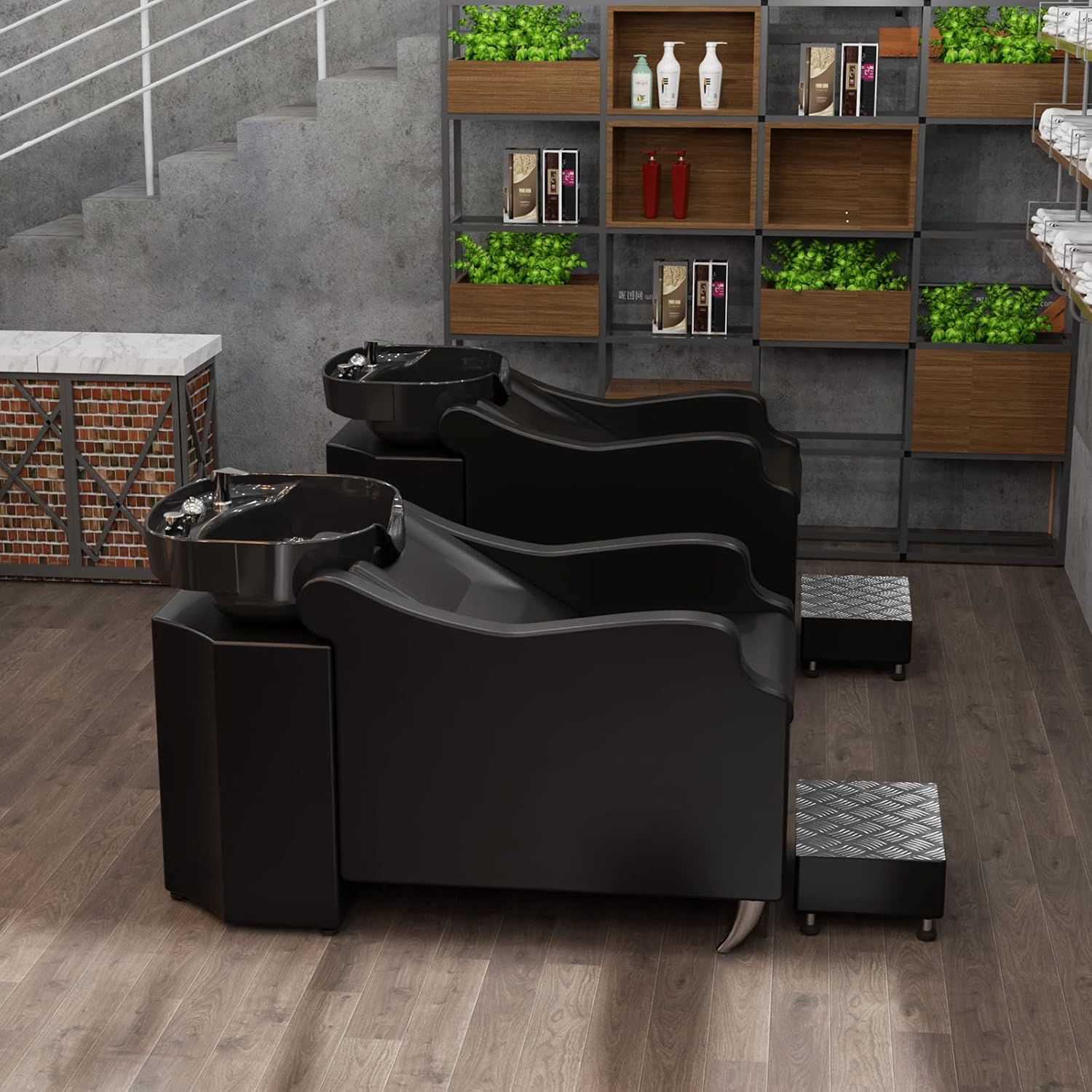
A shampoo bowl and chair unit is the dedicated station where a stylist washes a client’s hair — a reclined chair paired with a basin (the “bowl”) that connects to your salon’s water supply and drain. It sounds simple. You pick a chair that looks good, the bowl ships with it, done. But the part that determines whether installation runs $300 or $1,800 — and whether the unit ever works correctly — is the plumbing interface: where your existing water lines and drain are located relative to where the unit needs them to be. Product listings almost never foreground this. They lead with the chair’s weight rating and the bowl’s acrylic finish. The plumbing specs, when they appear at all, are buried. This guide surfaces what to check before you sign anything, walks through the decision points that separate a clean installation from a costly rework, and ends with a clear decision rule you can apply to your current deal.
The Three Numbers Every Listing Should Show (But Usually Doesn’t)
When you’re evaluating a shampoo unit — whether it’s a $650 entry unit from Collins or a $3,200 Pibbs Lexus series — there are three dimensional specs that govern whether it will install into your existing plumbing without modification:
1. Rough-in distance (supply lines) This is the horizontal measurement from the center of the bowl drain to where your hot and cold supply valves need to be. Most units expect supply connections at the wall, 8 to 10 inches apart on center. If your current rough-in sits 14 inches apart (common in older construction), you either need a plumber to re-stub, or you need a unit whose supply flexibility accommodates the variance. Salon Today Magazine’s buildout coverage notes that mismatched rough-in is the single most common reason a shampoo unit installation gets delayed past the scheduled opening date.
2. Drain centerline offset The drain on your bowl needs to line up — or come close enough to line up — with your floor drain stub. Units vary by how far the drain drops and at what horizontal offset from the chair base. A floor-mounted drain sitting 4 inches off-center from spec can be accommodated with an offset P-trap; a 12-inch miss typically requires opening the floor. Know your floor drain location before you order.
3. Deck-mount vs. wall-mount faucet configuration Some bowls are pre-drilled for a deck-mount faucet (the fixture sits on the bowl rim). Others are plumbed for wall-mount supply, where the faucet arm comes off the wall above the bowl. These are not interchangeable without modification. Wall-mount setups require a mixing valve (a valve that blends hot and cold to a set temperature) roughed into the wall; if yours isn’t there, you’re adding a plumber to your timeline before the unit ships.
Chair Type Determines More Than Comfort
The chair attached to the shampoo bowl isn’t just an ergonomic choice — it determines your plumbing access, your installation sequence, and your long-term maintenance access. There are three broad chair configurations in the professional market:
Free-standing recliners with a separate bowl pedestal. The chair and bowl connect via a bridge or are positioned close without a fixed mechanical link. This configuration gives you the most flexibility on floor drain location because the bowl pedestal can be positioned independently within a range. Collins and Kaemark both offer well-documented versions of this approach; operators in long-run reviews note that this setup is the most forgiving in retrofits where the drain stub isn’t exactly where you’d place it from scratch.
Integrated units where the chair mounts directly to the bowl cabinet. Here the chair, bowl, and plumbing cabinet are a single piece. The footprint is cleaner and the unit ships mostly assembled, but you have zero positional flexibility once the cabinet is anchored. The drain stub-out must be within spec — typically within 2 inches of center — or you’re reworking the floor. Pibbs, Belvedere, and Gamma & Bross all produce integrated units across price tiers. The Pibbs 5050 series is widely referenced in procurement discussions for its solid weight tolerance (spec sheets rate it to 350 lbs) and manageable rough-in window.
Hydraulic tilt-back chairs with bowl arm. The bowl is mounted on an adjustable arm connected to a hydraulically tilting chair. These are common in high-volume color bars and in barber-adjacent settings. The plumbing connection is flexible — the arm pivots — but the supply hoses are under more mechanical stress over time. Beauty Launch Pad’s backbar buying guide specifically flags hose-and-fitting inspection as an annual maintenance item for these configurations.
By the Numbers
| Configuration | Typical Rough-In Tolerance | Average Installation Labor (2026) | Best Fit |
|---|---|---|---|
| Free-standing recliner + separate pedestal | ±4–6 in. | $280–$450 | Retrofit, existing drain offset |
| Integrated cabinet unit | ±1–2 in. | $350–$600 | New build, precise rough-in |
| Hydraulic tilt-back with bowl arm | Flexible hose reach | $400–$700 | High-volume, multi-service |
Labor ranges reflect licensed plumber rates in mid-to-large U.S. markets; smaller markets typically run 15–25% lower. Per Professional Beauty’s procurement guidance, always budget a 20% contingency on plumbing labor for retrofit installs.
The Valve Question: Mixing Valves, Thermostatic Controls, and Why It Matters to Your Service
A mixing valve blends hot and cold water to a stable preset temperature before it reaches the faucet. A thermostatic valve (a more precise version) holds that temperature constant even when pressure in the building fluctuates — when a toilet flushes on the same line, for example. In a shampoo service, temperature stability isn’t a luxury detail; scalp burns are a liability issue and a client retention issue simultaneously.
Here’s the split in the market right now:
Entry-level units ($400–$800) typically ship with a standard two-handle deck faucet. Hot and cold are manually blended by the operator. There’s nothing wrong with this at low volume. It requires the stylist to re-check temperature at every service, which slows throughput.
Mid-range units ($900–$2,000) increasingly include a pre-blended single-lever faucet. Better than two handles, but still not pressure-compensating.
Premium units ($2,200+), and many mid-range units if you spec them correctly, can be ordered for or adapted to accept a thermostatic mixing valve roughed into the wall. Takara Belmont and Maletti both document thermostatic valve compatibility in their specification sheets. If your buildout is new construction, roughing in a thermostatic valve from the start adds roughly $150–$250 in materials and is almost always worth the cost when amortized across the service life of the chair.
Modern Salon’s coverage of shampoo area design consistently surfaces thermostatic valve compatibility as a differentiator that operators cite in hindsight — rarely prioritized at purchase, frequently wished for at year two.
Gray Market Units and the Warranty Problem
This is where the cost-per-service math gets uncomfortable. Shampoo bowl and chair units appear on wholesale marketplace sites at prices that look like 40–60% discounts against authorized dealer pricing. Some of those units are legitimate overstock. Many are units manufactured to different specs for international plumbing standards — specifically, different supply pressure ratings, different drain thread standards (NPT vs. BSP, which are not interchangeable without adapters), and faucet cartridges that aren’t serviceable by U.S. parts suppliers.
Professional Beauty’s equipment procurement guidance is direct on this point: gray market shampoo units frequently arrive without any warranty documentation, or with warranty language that requires return shipping to an overseas depot — effectively voiding the warranty for U.S. operators. At a $700 unit, that risk is manageable. At a $2,500 integrated unit, it represents real exposure.
The Salon Catalog position here is consistent across categories: verify the seller is an authorized dealer before you send payment. For Pibbs, that means purchasing through Pibbs-authorized distributors. For Belvedere, through their dealer network. Collins publishes an authorized dealer locator. If a listing doesn’t name the authorized dealer relationship, ask before you commit — and get the answer in writing.
Installation Sequencing: What Has to Happen Before the Unit Arrives
One of the more expensive mistakes in salon buildouts is ordering the unit before the rough-in is confirmed. Shampoo bowl units typically ship on freight (not UPS), with lead times ranging from 2 to 8 weeks depending on the brand and configuration. If the unit arrives and the rough-in isn’t ready — or isn’t right — you’re paying storage or rescheduling delivery. Either way, your opening date slips.
The correct sequence:
- Confirm drain stub location and take exact measurements (centerline to wall, centerline to adjacent wall).
- Pull the spec sheet for the unit you’re considering and verify rough-in tolerance.
- Confirm supply valve locations and mixing valve configuration.
- Order the unit.
- Rough-in plumbing to spec before the unit ships.
- Schedule licensed plumber for final connection on delivery day.
Salon Today Magazine’s buildout coverage recommends sharing the spec sheet — not just the product listing — with your plumber at step two, before money changes hands. Plumbers who haven’t installed a specific brand’s unit before may estimate based on the wrong assumptions about drain offset or supply spacing.
Decision Rule: If X, Then Y
If you’re retrofitting into an existing space where the drain stub location is fixed and non-negotiable, your first filter is drain-offset tolerance, not aesthetics. Start with free-standing recliner configurations with separate pedestals; they give you the most room to work with what you have. Don’t start with an integrated cabinet unit and try to make the plumbing fit.
If you’re building new or doing a full demo-and-rebuild, rough in for a thermostatic mixing valve from day one. The $200 upfront saves a wall opening later. Integrated units are the cleaner choice here — they look more finished and the installation is predictable when the rough-in is done to spec.
If you’re evaluating a listing that’s priced more than 30% below authorized dealer pricing, treat that as a flag, not a deal. Ask for the authorized dealer documentation before proceeding. The math on a gray market unit that needs a replacement faucet cartridge you can’t source domestically, or a warranty claim you can’t file, does not favor the discount.
If you’re adding a second or third unit to an existing plumbed wall, match the faucet configuration to what’s already in your wall. Switching from deck-mount to wall-mount supply on an existing run adds plumber time that quickly offsets any price difference between units.
The plumbing specs aren’t the glamorous part of this purchase. But they’re the part that determines whether your install is a one-day job or a three-week problem. Read paragraph four.