You’re a few weeks into cosmetology school and a brand rep shows up with a rolling case full of gleaming scissors — shears, in industry language — and a payment plan that sounds totally reasonable until you do the math. This is one of the most predictable moments in every student’s first year, and it catches a lot of people off guard because the tools are real, the pitch is polished, and you genuinely don’t know yet what you need. Shears are the single most personal tool a stylist owns: they’re the scissors specifically engineered for cutting hair, with blade geometry, handle offset, and steel hardness calibrated to reduce hand fatigue over a full workday. A good pair matters. But “good” at the student stage means something very different from what brand reps are usually selling — and the gap between what you need and what you’re being pitched is often $200 to $350 per pair. This guide breaks down what to actually buy, what to ignore, and how to think about upgrading later when the investment pays off.
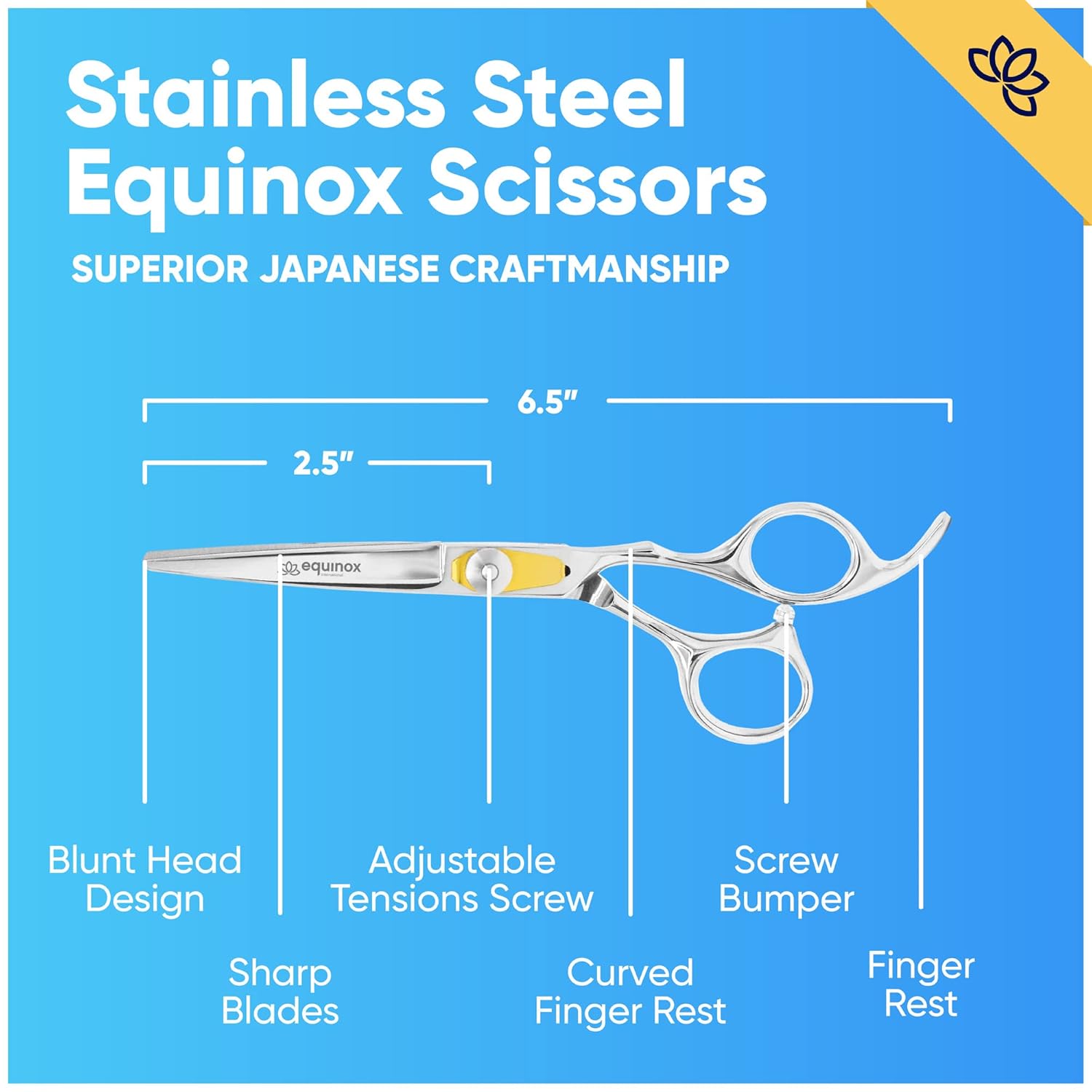
| EDITOR'S PICK[Fagaci Professional Hair Scisso…](https://www.amazon.com/dp/B07TJ69HW7?tag=greenflower20-20) | Mid-tier[Equinox Professional Razor Edge…](https://www.amazon.com/dp/B00KVYW1HA?tag=greenflower20-20) | Budget pick[Utopia Care Hair Cutting and Pr…](https://www.amazon.com/dp/B01C9E7MA0?tag=greenflower20-20) | |
|---|---|---|---|
| Blade material | — | Japanese Stainless Steel | Premium Stainless Steel |
| Blade length | 6" | — | — |
| Overall length | — | 6.5" | 6.5" |
| Tension screw | — | ✓ | — |
| Price | $69.99 | $14.42 | $7.29 |
| See on Amazon → | See on Amazon → | See on Amazon → |
What the Rep Is Selling vs. What You Actually Need Right Now
Brand representatives who visit cosmetology schools — and they visit often, per Behind the Chair’s student kit coverage — are typically selling professional-grade shears in the $180–$450 per-pair range. The pitch is logical: “These are what working stylists use. Start with the right tools.” And it’s not entirely wrong. But it skips a structural reality of the student phase that changes the calculus entirely.
Here’s what that reality looks like:
By the numbers:
- Average cosmetology program length: 1,500 hours (required minimum in most states)
- Typical student shear lifespan before first professional resharpening is needed: 6–12 months of school use
- Average cost of professional sharpening: $15–$30 per pair
- Entry-tier shear sets (two pairs) meeting school requirements: $30–$80
- Rep-pitched mid-tier sets typically offered at school: $200–$450
During your student hours, you are learning technique. You are not yet delivering paid services at full speed, you are not running a client book, and your cutting mechanics are still forming. Modern Salon’s coverage of student kit basics notes that shear damage during training — micro-nicks from dropped tools, blade misalignment from incorrect handling, and premature wear from textbook exercises on synthetic hair — is common and largely unavoidable. Running a $350 shear through that gauntlet is not a rite of passage; it’s an unnecessary financial hit.
The practical answer for most students: a solid two-pair set (one straight shear for blunt cutting, one thinning shear for texturizing and blending) in the $40–$90 range will carry you through your program hours competently. You want stainless steel with a basic convex edge (smoother blade profile that glides rather than pushes through hair), an offset or crane handle (positions the thumb lower than the fingers, reducing wrist strain over time), and a tension screw you can adjust yourself. Those features exist in the entry tier.
The Steel Story: What Grade Numbers Mean and When They Matter
This is where reps earn their commission, because steel specification is real — it’s just not as decisive at the student stage as the pitch implies.
American Salon’s overview of shear steel grades breaks it down clearly: the two most common steel types in professional shears are 440C stainless and Japanese VG-10 or V-Gold equivalent steels. The 440C grade is a high-chromium stainless alloy, widely used in entry-to-mid-tier professional shears — it sharpens reliably, holds an edge reasonably well, and is forgiving when resharpened. The Japanese steels (often labeled SUS440C equivalent or proprietary names like Hitachi AUS-8 or ZA-18 alloys) are harder, hold a finer edge longer, and are what you find in the $200–$600 professional tier.
The honest tradeoff: harder steel holds an edge longer between sharpenings but is more brittle — it will chip rather than dent if dropped. Softer alloys dull faster but survive the knocks of a training environment without catastrophic damage. For a student who drops tools on tile floors and is still developing clean cutting habits, the forgiveness of a mid-grade 440C shear is a practical advantage, not a compromise.
What to actually look for on the spec sheet when buying entry-level:
- Steel grade listed as 440 or 440C stainless — this is the baseline for a shear worth buying. Anything listed only as “surgical stainless” without a grade number is a signal to skip it.
- Convex blade edge (vs. beveled/serrated) — convex shears cut cleanly without pushing hair. Serrated blades grab and guide, which is useful for beginners but limits technique development.
- Adjustable tension screw — not a spring-loaded hinge. You need to be able to set blade tension yourself as the shear wears in.
- Offset or crane handle — not a symmetric (even) handle. The ergonomic benefit is real even at low price points.
Beauty Launch Pad’s comparison of entry-level shear sets confirms that several brands — Kenchii, Joewell’s student-line equivalents, and Hikari’s entry sets — hit these spec markers in the $50–$90 range for a two-pair kit.
The Upgrade Math: When Does a $300 Shear Actually Make Sense?
This is the question the rep never quite answers directly, so let’s answer it.
The ROI case for a higher-investment shear hinges on two variables: service volume and cut type frequency. A shear that holds a finer edge longer between sharpenings pays off when you are:
- Cutting 20+ clients per week, where cumulative blade fatigue becomes noticeable in cut quality and hand strain
- Specializing in precision or razor-like cutting techniques — blunt bobs, point cuts, slide cuts — where blade smoothness directly affects finish
- Operating as a booth renter or salon employee where your tools are your professional identity and client retention depends on consistent results
Behind the Chair’s booth renter toolkit coverage consistently frames the $150–$250 per-pair range as the practical sweet spot for a stylist transitioning from school to first job. This is where you get Japanese 440C-equivalent steel, a true convex edge, and a handle geometry that survives a full eight-hour shift. Brands commonly recommended in this tier by working stylists include Kenchii, Kissaki, Yasaka, and Juntetsu — all offer models in the $120–$220 per pair range with professional resharpening support and warranty coverage from authorized dealers.
The $300–$600 shear tier — brands like Joewell’s professional series, Kasho, and Hattori Hanzo at the upper end — is justified when you’re at full production volume, your cutting specialization is established, and you’ve developed enough hand knowledge to feel the difference in blade response. Stylists in long-run reviews consistently note that at this tier, the difference isn’t just longevity — it’s the physical feedback of the cut, which matters to a stylist doing 30+ precision cuts per week but is genuinely imperceptible to someone still building their 200th hour.
How to Handle the Rep When They Come Around
Knowing the math is useful. Knowing how to hold the line in a social environment is more useful.
Brand reps at school are typically independent sales contractors working on commission. They are skilled at building rapport quickly, creating urgency (“I’m only here today”), and anchoring the conversation at their price point before you’ve had a chance to evaluate alternatives. None of this makes them bad people — it makes them effective salespeople doing their job. Your job is to manage the interaction.
A few practical frames:
“I want to try them first.” Ask to hold the shear, open and close it, feel the tension. A good shear at any price point should feel smooth, not sticky or loose. If a rep won’t let you handle the tool before buying, that’s a signal.
“What’s the authorized dealer network?” This matters for warranty claims and resharpening support. Some brands sold at school events are legitimate; others are gray-market or distributor overstock with no manufacturer warranty path. Ask directly: Is this purchase covered by the manufacturer’s warranty, and where do I send it for authorized service? If the answer is vague, walk.
“I’m going to compare against Kenchii and Hikari this week.” Naming specific competitors re-frames the conversation. Reps at school often rely on students not knowing what else exists. Having two or three alternative brand names ready signals that you’re an informed buyer.
“What’s the return policy if my program director says these don’t meet kit requirements?” Many schools have specific kit requirement lists. Buying a shear set that doesn’t satisfy your program’s requirements — or that you won’t be allowed to use on the floor — is a real risk with impulse purchases at sales events.
The Decision Rule
Here’s the if/then framework, plain and simple:
If you are in your first 800 program hours: Buy a two-pair set (straight shear + thinning shear) in the $40–$90 range. Spec for 440C steel, convex edge, offset handle, adjustable tension. Kenchii’s entry line and Hikari’s student sets are commonly cited by working stylists as reliable options at this price. Spend the saved $150–$300 on color education, a quality brush set, or your state board exam prep.
If you are in your final 400 hours or actively interviewing for salon positions: This is a reasonable moment to move to the $150–$250 per-pair tier. You’re developing a specialty, you know your handle preference, and you’ll carry this tool into your first paying job. Research authorized dealers — SalonCentric and authorized online retailers are safer than school-event purchases for warranty continuity.
If a rep is offering you a $350+ set on a payment plan at your school: Ask for 48 hours, compare against what’s available through SalonCentric or authorized professional suppliers, and run the numbers on what that payment plan actually costs total. The urgency is theirs, not yours. A shear will still exist for purchase next week.
The tool that makes you a better stylist is not the most expensive one you can access — it’s the one that fits your hand, survives your training environment, and lets you focus on the technique you’re still building. Get that right first. The upgrade will make sense when the volume demands it, and by then you’ll know exactly what you’re buying.